
Of every mount in the game, the skeleton horse in Minecraft might be the most fascinating. It is undead but passive, rare but rideable, and it comes with a set of quirks — sunlight immunity, underwater breathing, fixed stats — that no other horse shares. Whether you have just seen your first bony steed in a thunderstorm or you are planning to make one your main mount, this overview covers what it is, how it behaves, and how it compares to every other horse in the game.
Think of this as the encyclopedia entry: the stats, the behavior rules, the edition differences, and the trivia. If you want the hands-on hunt instead, our guide to getting a skeleton horse in Minecraft walks through traps, taming, and saddling step by step.
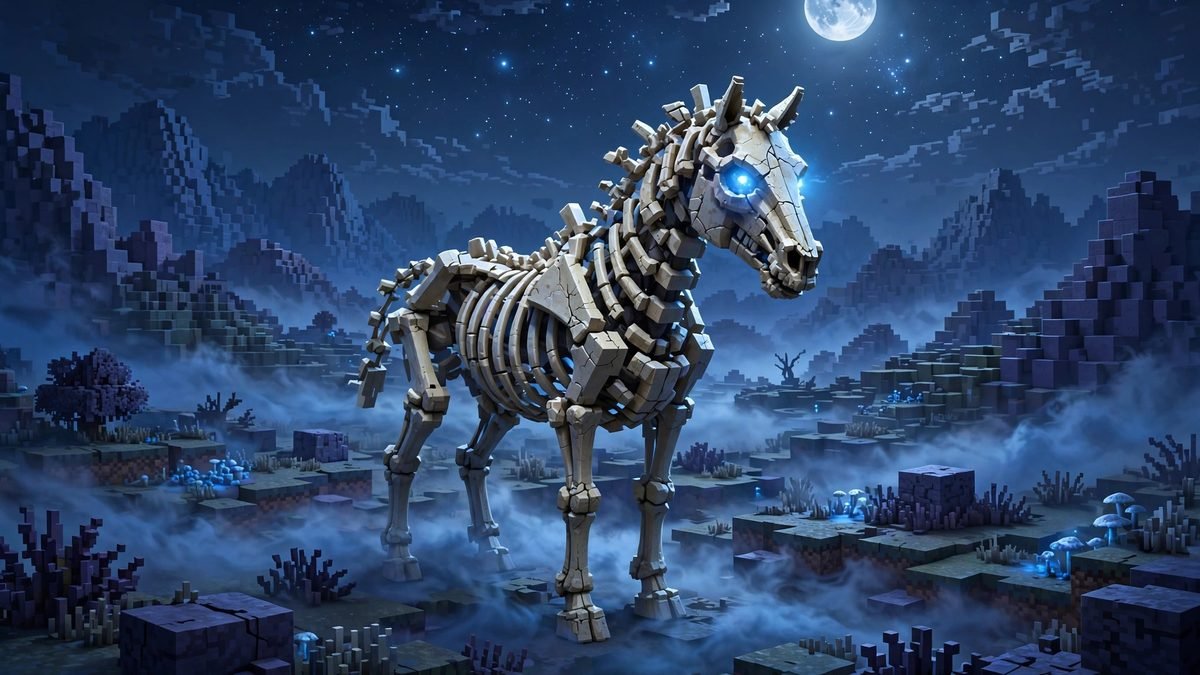
What Is a Skeleton Horse in Minecraft?
A skeleton horse in Minecraft is an undead skeletal horse mob — literally a horse made of bones, with glowing eyes and no skin. It belongs to the undead mob family (like zombies and skeletons), which gives it a whole set of special interactions: healing potions hurt it, harming potions heal it, and the Smite enchantment deals bonus damage to it.
Skeleton horses arrive in the world through the skeleton trap: during a thunderstorm, a tiny fraction of natural lightning strikes spawn a lone “trap horse” instead of striking normally. Approach within about 10 blocks and the trap springs — the horse splits into four skeleton horsemen, each a skeleton archer with an enchanted bow and helmet riding a skeleton horse. Defeat the riders, and the horses become completely passive and rideable.
Here is the detail that surprises most players: the horse itself is never really your enemy. Once separated from its rider, the skeleton horse in Minecraft is docile — it wanders, grazes (the animation plays, though it eats nothing), and waits for a saddle. The menace was always the archer on its back.
Skeleton Horse Stats: Health, Speed, and Jump
Unlike regular horses, whose stats roll randomly, the skeleton horse in Minecraft has fixed numbers — every single one is identical except for jump strength. Here is the full stat block, verified against the game’s data:
| Stat | Value | What It Means |
|---|---|---|
| Health | 15 HP (7.5 hearts) | Lower than most good regular horses; fragile in a fight |
| Speed | 0.2 | Exactly double the player’s walking speed (0.1) |
| Jump strength | 0.4 – 1.0 (avg ~0.7) | The only stat that varies; decides jump height |
A few things worth unpacking. The fixed 15 health means you always know what you are getting — no lottery like regular horse breeding, where you might get a slow, weak foal after hours of work. The 0.2 speed is respectable: brisk, but a well-bred regular horse can outrun it. Jump strength averaging 0.7 clears about one and a half to two blocks comfortably, enough for most terrain.
One odd visual quirk: because 15 is an odd number, the health bar does not show the last half-heart. Do not panic if your horse’s hearts look “wrong” — that is just how odd health values display.
Behavior and Quirks That Make It Unique
The stat block only tells half the story. The skeleton horse in Minecraft has the strangest behavior set of any mount:
- No sunlight burn. Unlike zombies and skeletons, skeleton horses are completely immune to daylight. Ride at high noon with zero worry.
- Breathes underwater. Skeleton horses do not drown, and you can ride one underwater without drowning yourself — genuinely unique among mounts. Underwater, their running speed and jump stay the same, though they sink more slowly.
- Cannot be bred or fed. No breeding, no apples, no hay. Every skeleton horse in your world comes from a trap, a spawn egg, or a command.
- Regenerates while ridden. Like regular horses, skeleton horses slowly regenerate health while you ride them.
- Undead potion logic. Splash potions of Healing damage it; splash potions of Harming heal it. Heal your bony mount with the “wrong” potion.
- Smite applies. The Smite enchantment deals bonus damage to skeleton horses, same as other undead mobs.
- Ignored by the wither. The wither boss does not target skeleton horses — a small mercy in the Nether.
- Creepers drop music discs. Because skeleton horses carry the “skeletons” entity tag, a creeper killed by one drops a music disc.
- Armadillos fear it. The horse counts as a threat to armadillos, making them curl into their shells.
The eating animation deserves a special mention: minecraft skeleton horses will lower their heads as if grazing, but unlike sheep, no grass is actually consumed. It is pure theater — charming, pointless theater.
Skeleton Horse vs Regular Horse: Which Should You Ride?
So should your main mount be a skeleton horse in Minecraft or a classic bred horse? Honest comparison:
| Feature | Skeleton Horse | Regular Horse |
|---|---|---|
| Health | Fixed 15 HP | 15–30 HP (varies) |
| Speed | Fixed 0.2 | 0.11–0.34 (a great one is much faster) |
| Jump | 0.4–1.0 | 0.4–1.0 |
| Sunlight | Immune | Immune (not undead) |
| Underwater riding | Yes, no drowning | No — you will drown |
| Breeding | Impossible | Yes, with stat inheritance |
| Horse armor | No (Java) | Yes |
| How to get | Trap, egg, or command | Plains/savanna, then breed |
| Style points | Maximum | Respectable |
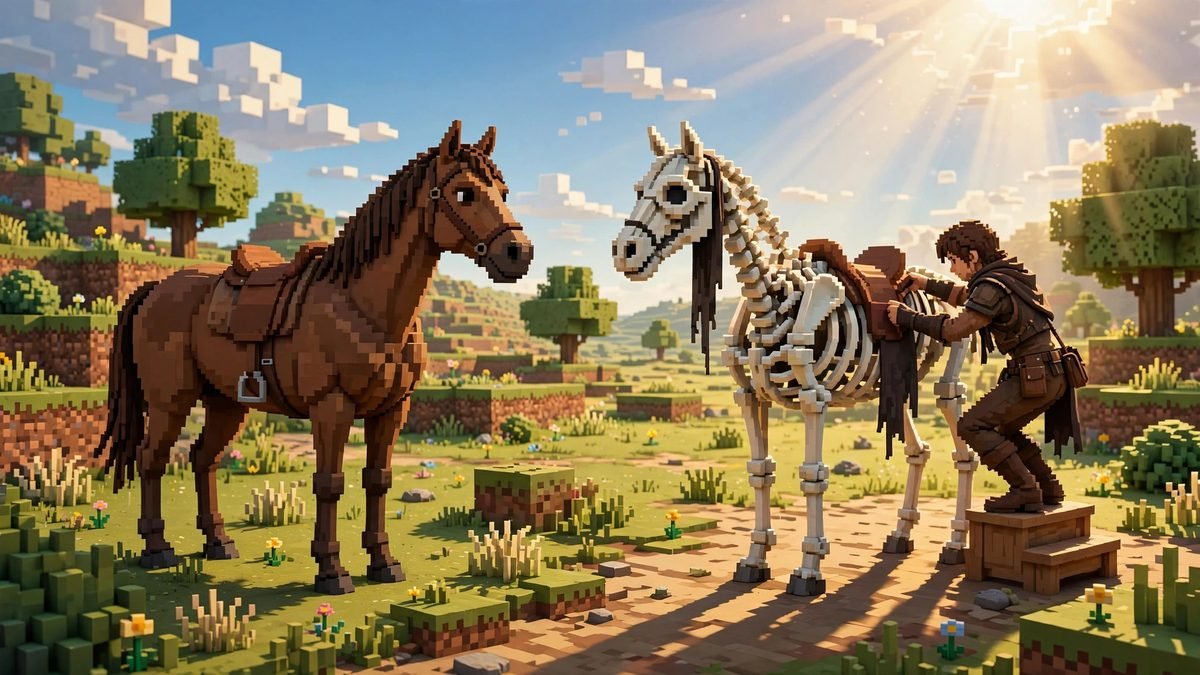
The verdict: a top-tier bred horse beats a skeleton horse on raw stats, but the skeleton horse wins on convenience (no breeding grind), underwater utility, and sheer cool factor. Most players who own one ride it everywhere anyway — because arriving on a skeleton horse is a statement.
Java vs Bedrock: The Differences That Matter
The minecraft skeletal horse behaves slightly differently depending on your edition, and the differences trip people up:
- Taming: In Bedrock Edition, skeleton horses are always tamed no matter how they spawn. In Java, horses from triggered traps spawn already tamed, and commands can tame others (which even grants the “Best Friends Forever” advancement).
- Peaceful mode: In Java, traps never spawn on Peaceful — but horses that already exist stay. Flip to Peaceful mid-trap and the riders vanish, leaving free horses.
- Conduit danger: In Bedrock, conduits treat skeleton horses as hostile mobs and will attack them. Keep your bony mount away from your ocean base’s conduit.
- Baby horses: Baby skeleton horses only exist via spawn egg. In Bedrock they cannot grow up normally.
- Horse armor: Skeleton horses cannot wear horse armor in Java Edition — do not waste diamond horse armor on one.
Baby Skeleton Horses and Skeleton Jockeys
Two rare sights worth knowing about. First, baby skeleton horses: they cannot spawn naturally at all. The only way to see one is a spawn egg in Creative, and in Bedrock they stay babies forever. Killing one yields nothing — so do not.
Second, skeleton horsemen are not the only riders. There is a small chance — about 15% — that a baby zombie, husk, zombie villager, or drowned near an adult riderless skeleton horse will climb on and form a jockey. A baby zombie riding a skeleton horse is one of the game’s rarest and most chaotic encounters.
And yes — the minecraft skeleton horsemen from traps are always regular skeletons. They never spawn as strays, bogged, or wither skeletons, no matter the biome.
What Players Get Wrong About Skeleton Horses
A few persistent myths, corrected:
- “They burn in daylight.” No. This is the most common mix-up with zombies. Skeleton horses are fully sun-proof.
- “You can breed two of them.” No. Skeletal horse minecraft breeding is impossible — love mode does nothing.
- “Feeding heals them.” No. They do not eat. Splash potions of Harming (yes, Harming) are the healer’s choice.
- “They despawn like hostile mobs.” Triggered or tamed horses are persistent. Only the untriggered trap horse despawns — after 15 minutes, even if named.
- “They drop something special.” Just 0–2 bones (up to 5 with Looting III) and 1–3 XP. The horse is the reward, not the loot.
Nicknames and Search Spellings
One fun community note: players search for this mob under every spelling imaginable. Search engines see queries like “skeleton horses minecraft”, “skele horse” and “skelleton horse” as the classics, “skeletom horse” shows up more than you would expect, and plenty of people just type the mob’s vibe rather than its name. Whatever you call it — skele horse, skelleton horse, or the full proper name — it is the same bony mount, and this guide covers it all.
Skeleton Horse in Minecraft FAQ
Can you tame a skeleton horse in Minecraft?
In Java, trap horses spawn already tamed; in Bedrock, skeleton horses are always tamed. Others can be tamed via commands in Java. You cannot tame one with food like a regular horse.
Do skeleton horses despawn?
An untriggered trap horse despawns after 15 minutes. Once triggered, tamed, or ridden, the horse is persistent and will not despawn.
Can skeleton horses wear armor or be given a chest?
No horse armor in Java Edition, and no chests like donkeys. A saddle is the only equipment they take (and saddles cannot be crafted — find them in dungeon, temple, or bastion chests).
Are skeleton horses faster than regular horses?
At a fixed 0.2 speed, they beat average regular horses but lose to well-bred ones (up to ~0.34). Their real advantages are underwater riding and zero breeding effort.
Do skeleton horses burn in sunlight?
No — unlike zombies and skeletons, they are completely immune to daylight.
Conclusion
The skeleton horse in Minecraft is a bundle of delightful contradictions: undead but gentle, rare but low-maintenance, fragile on paper but nearly unkillable by sunlight and water. Fixed stats mean no surprises, and its quirks — underwater riding, wither immunity, potion-reversed healing — make it far more interesting than the numbers suggest.
For the full technical reference, check Minecraft Wiki’s skeleton horse page. And when you are ready to claim one of your own, our guide to getting a skeleton horse in Minecraft covers every method from thunderstorm hunting to summon commands.