
Learning how to make a helmet in Minecraft is one of the first crafting milestones every player hits — and for good reason. The helmet is the cheapest piece of armor to craft, it goes on first in every armor set, and certain helmets (gold, turtle shell) have special abilities no other armor piece offers. Whether you need your first iron helmet or you are upgrading to netherite, the recipe never changes.
This guide covers the exact crafting pattern, every minecraft armor helmet type from leather cap to netherite, the turtle shell’s water-breathing trick, the best enchantments, and how to repair your helmet when it gets battered.
Table of Contents
How to Make a Helmet in Minecraft: The Recipe
The helmet recipe is wonderfully simple. You need 5 units of one material and a crafting table:
- Open the 3×3 crafting grid.
- Fill the entire top row with your material (3 units).
- Place one unit in the left and right slots of the middle row (2 units), leaving the center slot empty.
- Drag the finished helmet from the output slot into your inventory.
The shape looks like an upside-down U — or, if you squint, a little helmet. The bottom row stays completely empty. Get the pattern wrong and you get nothing, so double-check that the middle slot of the second row is empty before you wonder why the output is blank.
Craftable materials are leather, copper ingots, iron ingots, gold ingots, diamonds, and turtle scutes. Five of any one of these makes its helmet. Two exceptions to know: chainmail helmets cannot be crafted at all (buy them from an armorer villager or loot them from mobs), and netherite helmets are never crafted directly — you upgrade a diamond helmet at a smithing table instead.
Every Minecraft Armor Helmet Type, Ranked
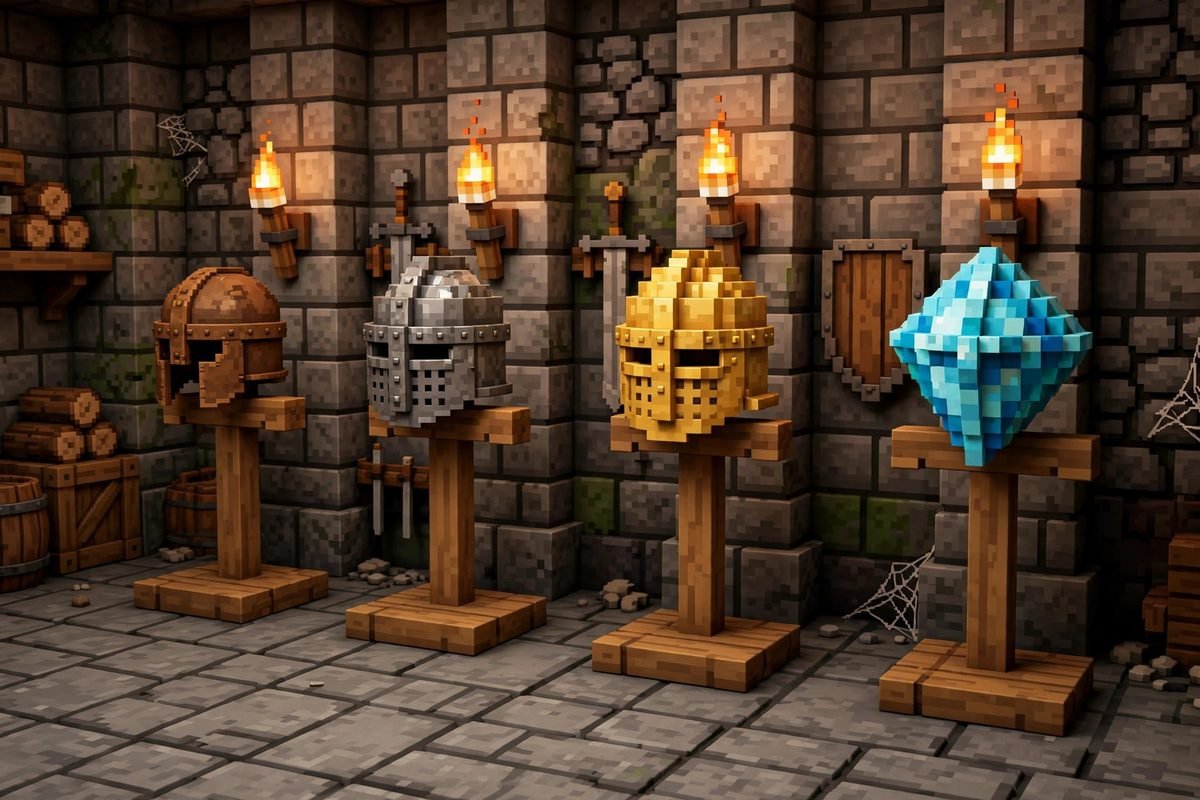
There are eight helmets in the game, and each minecraft armor helmet has its own armor value, durability, and perks. Here they are from weakest to strongest:
| Helmet | Armor | Durability (Java) | Special Notes |
|---|---|---|---|
| Leather Cap | 1 | 55 | Can be dyed any color; cheapest option |
| Golden Helmet | 2 | 77 | Piglins will not attack you; best enchantability |
| Copper Helmet | 2 | 121 | Newer tier; decent early-game bridge |
| Chainmail Helmet | 2 | 165 | Not craftable — trade or loot only |
| Iron Helmet | 2 | 165 | The workhorse; best value per ingot |
| Turtle Shell | 2 | 275 | Grants 10 seconds of Water Breathing |
| Diamond Helmet | 3 | 363 | +2 armor toughness; upgradeable |
| Netherite Helmet | 3 | 407 | +3 toughness, knockback resistance; fireproof item |
A few things worth noticing in that table. First, iron is the sweet spot for most of the game: the same 2 armor points as gold, copper, and chainmail, but with more than double the durability of gold. Second, the jump to diamond is the biggest defensive leap in the game — 3 armor points plus toughness that meaningfully blunts big hits. Third, the turtle shell punches far above its tier thanks to its unique ability, which we will cover below.
Helmet-by-Helmet Breakdown
Leather Cap: The Starter
Five leather from cows, horses, or llamas gets you a cap with 1 armor point and a fragile 55 durability. It is barely protection, but it is protection — and the leather cap is the only helmet you can dye, making it the fashion choice. Dye the cap in a crafting grid with any dye for a custom color, or combine it with a cauldron of dyed water in Bedrock.
Golden Helmet: The Piglin Pass
Five gold ingots make a helmet with 2 armor and low durability — but the golden helmet has the highest enchantability in the game (25), meaning it rolls the best enchantments at the table. More importantly, wearing any single piece of gold armor stops piglins from attacking you in the Nether. A golden helmet is the cheapest “piglin passport” in the game, and every Nether explorer should keep one in a shulker box.
Copper Helmet: The New Middle Child
Five copper ingots craft a helmet matching iron’s 2 armor points with 121 durability. Copper is abundant early, so this is a solid bridge helmet between leather and iron — especially in newer versions where copper gear fills out the progression curve.
Chainmail Helmet: The Uncraftable
You cannot craft chainmail, full stop. Buy a chainmail helmet from a journeyman-level armorer villager for emeralds, or farm one from armored zombies, skeletons, and piglins (an 8.5% drop chance, better with Looting). At 2 armor and 165 durability it is statistically identical to iron, so treat it as a collector’s item rather than a goal.
Iron Helmet: The Workhorse
Five iron ingots, 2 armor, 165 durability. This is the helmet most players wear for most of the game, and there is no shame in that — iron is cheap, renewable through iron farms, and perfectly adequate until you are swimming in diamonds.
Turtle Shell: The Diver’s Best Friend
Five turtle scutes (dropped by baby turtles when they grow up) craft the turtle shell: 2 armor, a hefty 275 durability, and a unique perk — 10 seconds of Water Breathing every time you enter water. The effect recharges the instant you touch air, so with a turtle shell you effectively get a free breath extension on every dive. It is also the brewing ingredient for the Potion of the Turtle Master, which massively slows you but cuts damage taken. For ocean monument raids, the turtle shell plus Respiration III is the budget dream setup.
Diamond Helmet: The Big Leap
Five diamonds buy you 3 armor points, 363 durability, and +2 armor toughness — toughness being the hidden stat that reduces damage from strong hits. This is the helmet you wear into the End, into ancient cities, and into every fight that matters.
Netherite Helmet: The Final Form
You do not craft netherite — you upgrade. At a smithing table, combine a diamond helmet with a netherite ingot and a netherite upgrade template. The result keeps the diamond helmet’s enchantments and gains 3 armor, +3 toughness, 407 durability, 10% knockback resistance, and immunity to lava and fire as an item. It is the best helmet in the game, full stop.
How to Make a Helmet in Minecraft: Step-by-Step for Beginners
If this is your first craft ever, here is the full chain from nothing to helmet:
- Get wood: Punch a tree, craft planks, then a crafting table.
- Get your material: For your first helmet, kill cows for 5 leather (easiest) or mine 5 iron ore with a stone pickaxe and smelt it in a furnace.
- Open the crafting table and place the 5 materials in the upside-down U pattern: full top row, two sides of the middle row.
- Equip it: Open your inventory (E on Java) and drag the helmet into the head armor slot at the top of the armor slots — or right-click while holding it.
Original tip: craft your first helmet before your first chestplate. Five materials versus eight means the helmet is the cheapest armor piece in the game, and head protection first is the most efficient use of early iron. Too many beginners save up for a full set while taking full damage — grab the helmet at five ingots and keep mining in (relative) safety.
Best Enchantments for Helmets
A helmet really comes alive at the enchanting table. The best picks:
- Protection IV: The all-rounder — reduces nearly all damage. First priority on every helmet.
- Respiration III: Extends underwater breathing time dramatically. Essential for ocean exploration.
- Aqua Affinity: Removes the mining-speed penalty underwater. Pair with Respiration for a true diving helmet.
- Thorns III: Reflects damage back at attackers. Great for AFK safety, but it eats durability fast.
- Unbreaking III: Effectively quadruples your helmet’s lifespan.
- Mending: Repairs the helmet with XP you collect. The endgame must-have.
- Fire Protection / Blast Protection / Projectile Protection: Situational specialists — Fire Protection for the Nether, Blast Protection for creeper country, Projectile Protection for skeleton-heavy areas. Note these are mutually exclusive with each other and with regular Protection.
Avoid the curses (Binding and Vanishing) unless you enjoy suffering. And remember the golden helmet’s secret: with enchantability 25, it rolls level-30-quality enchantments more easily than any other helmet — some players keep a “golden enchanting helmet” just for rolling great books at the table.
How to Repair a Helmet
Helmets wear out, but you have three repair paths:
- Anvil + material: Combine the damaged helmet with units of its crafting material (iron ingots for an iron helmet, diamonds for diamond, scutes for turtle shell). Each unit restores 25% durability, and enchantments are preserved.
- Grindstone or crafting grid: Combine two damaged helmets of the same type. Durabilities add together plus a 5% bonus — but all enchantments are wiped. Perfect for unenchanted spares.
- Mending: Wear the helmet while collecting XP and it repairs itself for free. This is the long-term answer for any helmet you care about.
For the full mechanics of the grindstone method — including when combining beats repairing and how it strips enchantments — see our grindstone guide.
Common Mistakes When Making a Helmet
- Wrong pattern. The center slot of the middle row must be empty. A full 3×3 of ingots is a block, not a helmet.
- Trying to craft chainmail. It has never been craftable. Trade or loot it.
- Trying to craft netherite directly. Netherite gear only comes from upgrading diamond gear at a smithing table with an upgrade template.
- Skipping the turtle shell. Players rush to diamond and never discover that a scute helmet is the best diving gear in the game.
- Entering the Nether without gold. One golden helmet (or any gold piece) prevents most piglin ambushes. It is the cheapest insurance in the game.
- Enchanting in the wrong order. Put Mending on early via anvil before stacking other enchantments, or the XP costs spiral.
Helmet FAQ
How to make a helmet in Minecraft with iron?
Place 5 iron ingots in a crafting table: 3 across the top row, then 1 in each side slot of the middle row. That crafts an iron helmet with 2 armor points and 165 durability.
What is the strongest helmet in Minecraft?
The netherite helmet: 3 armor, +3 armor toughness, 407 durability, knockback resistance, and it cannot burn in lava. Upgrade a diamond helmet at a smithing table with a netherite ingot and upgrade template.
Can you make a helmet in Minecraft without a crafting table?
No — the helmet needs the 3×3 grid. Your inventory’s 2×2 grid cannot craft it. Build a crafting table from 4 planks first.
Which helmet lets you breathe underwater?
The turtle shell, crafted from 5 turtle scutes, grants 10 seconds of Water Breathing each time you submerge. Enchant it with Respiration III for serious diving.
Do piglins attack you if you wear a golden helmet?
No — wearing any one piece of gold armor, including just a golden helmet, stops piglins from turning hostile on sight. Piglin brutes in bastions still attack regardless.
Can leather helmets be dyed?
Yes. The leather cap is the only dyeable helmet — combine it with dye in a crafting grid (or a dyed-water cauldron in Bedrock) for any color you like.
Conclusion
Mastering how to make a helmet in Minecraft is really about knowing the pattern — five materials in an upside-down U — and then choosing the right tier for the job: iron for everyday value, gold for Nether diplomacy, turtle shell for diving, diamond for serious fights, and netherite for the endgame. Enchant it well, repair it smartly, and your head will stay attached through everything the game throws at you.
For the complete stat tables on every tier, see Minecraft Wiki’s helmet page. And when your favorite helmet starts looking battered, our grindstone guide walks through repairing and disenchanting the smart way. Now go craft that helmet — your future self, ambushed by skeletons at midnight, will thank you.