
Every lava-related project in Minecraft starts with the same object: the minecraft lava source block. It’s the still, full cube of lava — the only form you can pick up with a bucket, the only form that feeds a dripstone farm, and the form that behaves completely differently from the flowing lava around it. Confuse the two and you’ll waste buckets on uncollectible flows; understand the difference and lava becomes one of the most useful resources in the game.
This guide covers the minecraft lava source block from every angle: what it is and how to identify one, the bucket rules, why lava (unlike water) never makes new sources, the dripstone-and-cauldron farm that makes lava renewable, and — answering the eternal “where can i find lava in minecraft” — every reliable location in the Overworld and Nether. For the full mechanics of lava as a block (damage, flow, uses), see our Minecraft lava block guide.

Table of Contents
What Is a Lava Source Block?
A minecraft lava source block is lava in its still state: the full, calm, non-flowing cube. It’s the “origin” block — every lava flow you’ve ever seen traces back to one or more source blocks. Underground lava lakes are built almost entirely from sources stacked together, while the dramatic lavafalls pouring down cliffs are flowing lava fed by a single source at the top.
The distinction matters because the game treats the two states very differently:
- Only source blocks can be collected. Right-click a source with an empty bucket and it vanishes into your bucket as a lava bucket. Right-click flowing lava and nothing happens — this is the #1 lava frustration in the game.
- Only source blocks feed dripstone farms. The renewable-lava trick requires a genuine source above the stalactite; flowing lava does nothing.
- Only source blocks count for obsidian. Water hitting a lava source makes obsidian; water hitting flowing lava makes cobblestone. Know which you’re looking at before you pour.
- Sources never disappear on their own. A source block sits forever until bucketed, displaced, or (in rare cases) converted — unlike flowing lava, which can settle and vanish.
How to Identify a Source Block
In the wild, telling source from flowing takes a trained eye. Tricks that work:
- Stillness: source blocks don’t visibly move; flowing lava has a clear directional shimmer. In a calm lake, the flat top surface is almost all source blocks.
- Fullness: source blocks render as full cubes; flowing lava thins out with distance from the source, getting visibly shallower.
- The bucket test: when in doubt, click it with an empty bucket. If you get a lava bucket, it was a source. (Carry a water bucket too — the standard lava-safety pair.)
- Edges of pools: the outermost ring of a lava lake is usually flowing; the interior is sources. Aim for the middle.
- Single blocks: a lone lava block sitting in a wall or floor (like the ones in village weaponsmiths) is virtually always a source.
Collecting Source Blocks: Bucket Rules
The mechanics of harvesting a minecraft lava source block:
- Right-click the source with an empty bucket. The source vanishes; you get a lava bucket. That’s the whole interaction.
- Lava buckets don’t stack. Each one takes its own inventory slot — plan accordingly for big collection runs.
- Placing it back (right-click with the lava bucket) recreates a source block wherever it lands. One bucket in, one source out: perfectly conserved.
- Full cauldrons work too. A cauldron filled with lava (via dripstone, see below) can be scooped with a bucket just like a source block.
- Flowing lava is uncollectible. Worth repeating because it bites everyone once: if the bucket does nothing, you’re clicking flow, not source.
Why Lava Never Makes New Sources (Unlike Water)
Every Minecraft player knows the water trick: place two water sources with one block between them and a third source appears. New players inevitably try the same thing with lava — and it never works. The game’s data is explicit: lava has “creates sources: no.” Two adjacent lava sources just sit there, stubbornly refusing to multiply.
This single rule shaped the entire history of lava in Minecraft. Before the dripstone mechanic arrived, every bucket of lava you used was permanently gone from that pool — lava was a finite resource you had to keep finding. It made lava precious in a way water never was, and it made lava-powered super-smelters a genuine logistical achievement.
Two exceptions exist for the technically inclined:
- The
lavaSourceConversiongame rule (Java Edition): set it totrueand lava starts forming new sources from adjacent sources, exactly like water. It’s off by default and counts as a cheat-adjacent tweak, but it’s there for mapmakers and custom servers. - Commands:
/setblockand/fillwithminecraft:lavaplace source blocks directly, no bucket required.
Where Can I Find Lava in Minecraft? Every Location
The eternal question — where can i find lava in minecraft — has more answers than most players realize. Ranked from easiest to most adventurous:
Overworld locations
- Surface lava lakes: small pools generate above Y=0 in virtually any biome. They’re the fastest early-game lava — just walk until you see the glow (and the occasional burning tree).
- Deep caves (Y=-55 to -63): lava replaces air in caves and canyons at these depths, and lava aquifers fill below Y=0. This is also prime diamond territory, so bring buckets on every mining trip.
- Lava springs: single source blocks pouring down cliff faces, ravine walls, and cave walls — follow the flow upward to find the collectible source.
- Village weaponsmiths: plains, snowy plains, and desert weaponsmith buildings contain 2 lava source blocks each (savanna has 1). The single safest, most convenient early-game lava in existence.
- Strongholds: the End portal room holds 15 source blocks — 3 along each side wall and 9 beneath the portal frame.
- Woodland mansions: 2 blocks in the forge room plus a secret “lava room” hiding 25 blocks.
Nether locations
- Lava oceans: the Nether’s seas of lava sit at y=32 and stretch for hundreds of blocks — effectively infinite source blocks, if you can survive the neighborhood.
- Underground pockets: large lava pockets generate below y=19, sometimes connecting to surface lakes.
- Structures: single sources in nether fortress well rooms, plus lava in ruined portals and bastion remnants.
My original tip: for a new world’s first lava, skip the caves and check villages first. A weaponsmith’s two source blocks are free, safe, and enough to fuel your first enchanting setup and nether portal. Mark the village on your map — you’ll be back for more.
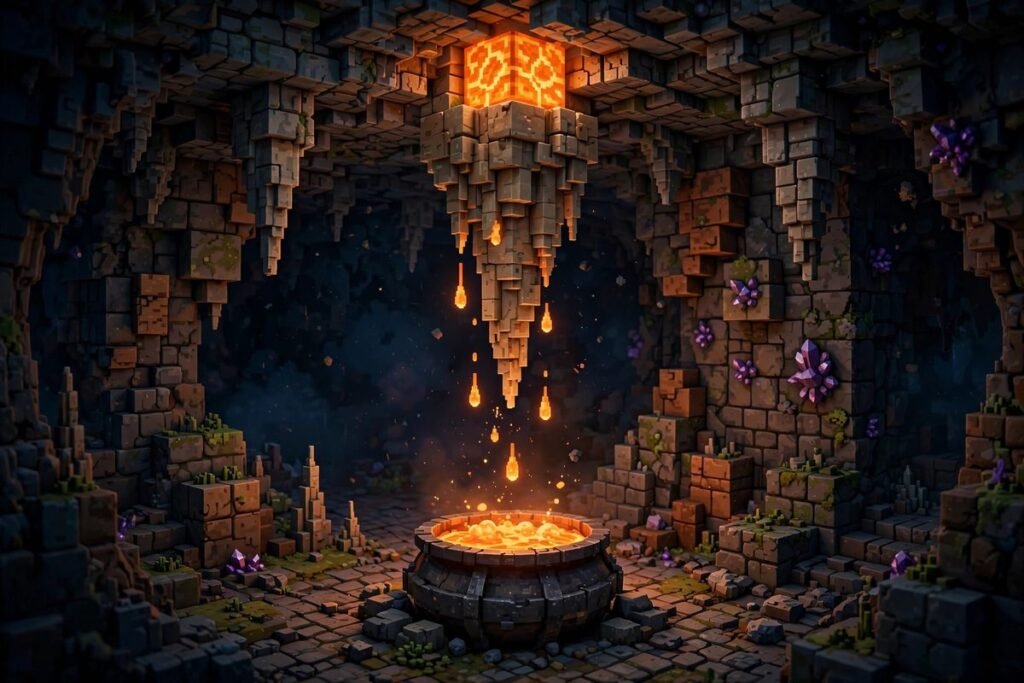
The Dripstone Farm: Renewable Source Blocks
Since the Caves & Cliffs update, the minecraft lava source block is effectively renewable — without consuming the source. The setup:
- Place a cauldron on the ground.
- Above it, hang a pointed dripstone stalactite (less than 11 blocks tall) from a solid block.
- Put a lava source block directly above the block the stalactite hangs from.
- Enclose the lava in non-flammable blocks (stone, cobblestone) so nothing catches fire.
- Ensure there’s nothing but air between the stalactite tip and the cauldron, with the cauldron within 10 blocks below the tip.
Then wait. Each random tick, there’s a 15/256 (~5.9%) chance the stalactite completely fills the empty cauldron with lava — averaging about 19 minutes per bucket (roughly one Minecraft day). The source block above is never consumed, so one source fuels infinite buckets. Scoop the full cauldron with a bucket and the cycle restarts.
Scaling is linear: ten setups produce ten times the lava. A wall of 20–30 dripstone-cauldron pairs runs a serious super-smelter operation with zero mining trips. Pointed dripstone itself comes from dripstone caves or from wandering traders (2 for 1 emerald).
Common reasons farms fail: a non-air block between tip and cauldron, the stalactite 11+ blocks tall, the cauldron more than 10 blocks below the tip, or the “source” above actually being flowing lava. Check each one and the drips will start.
What to Do With Your Source Blocks
Once you’re collecting the minecraft lava source block reliably, the uses pile up:
- Super fuel: a lava bucket smelts 100 items — the best furnace fuel in the game. A dripstone farm makes coal obsolete.
- Obsidian on demand: pour water over a source block for obsidian (nether portals, enchanting tables, beacons).
- Mob farms: thin lava blades damage mobs in automated farms.
- Lighting: lava emits light level 15 — encased in glass, it’s the brightest decorative light available.
- Defense: moats and lava walls remain the simplest base defense in the game.
- Trash disposal: one source block in a pit deletes unwanted items permanently.
Minecraft Lava Source Block FAQ
Where can i find lava in minecraft early in the game?
Check village weaponsmith buildings (free source blocks, no danger) or walk the surface looking for lava lakes above Y=0. For bulk lava, mine down to Y=-55 or visit the Nether.
Can you pick up flowing lava with a bucket?
No — only the still minecraft lava source block can be bucketed. Flowing lava is uncollectible.
How do you make an infinite lava source?
Use the dripstone method: a lava source above a pointed dripstone stalactite dripping into a cauldron. The source is never consumed, so buckets are infinite. (Alternatively, enable the lavaSourceConversion game rule on Java.)
Do lava source blocks run out?
Bucketing a source removes that block permanently — but with a dripstone farm, one source produces unlimited buckets, so effectively no.
What’s the difference between a lava source block and flowing lava?
The source is the still, full, collectible cube; flowing lava is the thinner streams spreading from a source (up to 3 blocks out in the Overworld, 7 in the Nether). Only sources can be bucketed, farm-fed, or turned into obsidian.
Conclusion
The minecraft lava source block is small — one glowing cube — but it sits at the center of half of Minecraft’s best systems: fuel, obsidian, farms, lighting, and defense. Learn to spot one (where can i find lava in minecraft is now a solved problem), respect the bucket rules, and build one dripstone setup, and you’ll never make another lava run again.
For lava’s full technical profile — damage, flow speeds, and fire rules — see our Minecraft lava block guide, and check Minecraft Wiki’s pointed dripstone page for the exact farm mechanics.