
Let us be upfront: classes missions forest shop analysis playbattlesquint is not a real phrase. It reads like a garbled search — five sensible gaming fragments (“classes,” “missions,” “forest,” “shop analysis”) glued to a mangled brand name (“playbattlesquint,” which is almost certainly a typo of PlayBattleSquare). If you typed this, you were probably hunting for gaming guides about character classes, missions, forest levels, or in-game shop strategy. So that is exactly what this article delivers: a complete guide to all four topics, plus the honest story behind the strange query itself.
No judgment on the search. Millions of mangled strings like this hit search engines every day — autocomplete collisions, voice-to-text misfires, pocket-typing accidents, and copy-paste errors all produce queries that look like keyboard soup. The useful response is not to pretend the string is a real term. It is to decode the fragments and answer the intent underneath. Let us break it down.
Decoding the Query: Five Fragments, One Intent
Pulling classes missions forest shop analysis playbattlesquint apart tells the whole story:
- “Classes” — character classes: the warrior/mage/rogue archetypes that define role-playing games and many shooters.
- “Missions” — quests and missions: the structured objectives that carry a game’s story forward.
- “Forest” — forest levels, forest biomes, or forest-themed game content.
- “Shop analysis” — analysis of in-game shops: what is worth buying, what is a trap, and how virtual economies work.
- “Playbattlesquint” — the mangled tail. It is one letter away from “PlayBattleSquare,” a gaming blog. This fragment suggests the searcher was looking for guides on a gaming site like it — quite possibly on the site you are reading right now.
Put together, this looks like someone searching across several gaming topics at once — maybe through a broken autocomplete chain — and the search engine stitched the fragments together. The intent underneath is clear: I want practical gaming guides. So here is the practical guide: classes, missions, forest content, and shop analysis, each explained properly.
Classes: The Foundation of Character Choice
Character classes are the oldest idea in gaming. The concept comes from tabletop role-playing games, where a “class” bundled a character’s abilities, weaknesses, and role into one package. Video games adopted the idea wholesale, and today classes appear in RPGs, shooters, MOBAs, battle royales, and even some survival games.
The classic trio
Almost every class system is a variation on three archetypes:
- Warrior / Tank: High health, heavy armor, melee combat. Soaks damage for the team. The straightforward pick for players who like to charge in.
- Mage / Caster: Devastating ranged damage through spells or abilities, but fragile up close. High skill ceiling, high reward.
- Rogue / Scout: Fast, stealthy, precision damage. Excels at hit-and-run tactics and objectives that need speed rather than force.
Most modern games add support and hybrid variants — healers, engineers, summoners, paladins that blend tank and healer, spellblades that blend mage and warrior. The labels change; the triangle does not.
How to pick a class
Beginners should pick the class that matches their patience level, not the one that looks coolest. Tanks and warriors forgive mistakes — you can take hits while you learn. Mages and rogues punish mistakes — one wrong move and you are respawning. A good rule of thumb: play your first class through the early game, then switch once you understand the mechanics. Most games make respecing cheap early on, precisely so new players can experiment.
Advanced players think in terms of team composition. A team of four damage-dealers loses to a balanced squad with a tank and a healer, because survivability multiplies damage output over time. In cooperative games, the “best” class is the one your team is missing.
Original insight: classes are really about decision load
Here is something most class guides miss. The real difference between classes is not damage numbers — it is how many decisions per minute they demand. A warrior asks: who do I hit next? A support asks: who needs healing, who needs shielding, where do I position, and when do I use my ultimate? If you are new, exhausted, or playing casually, choose the class with the lowest decision load. You will have more fun, and fun is the stat that matters.
Missions: How Games Structure Play
Missions — called quests in RPGs, operations in shooters, heists in crime games — are the skeleton of modern game design. They give players goals, pacing, and rewards. Understanding mission structure makes you a better player, because you start to see the designer’s intent behind each objective.
Main missions vs side missions
Main missions advance the story. They are usually the longest, most scripted, and best-rewarded content. Side missions are optional — fetch quests, bounty hunts, collectibles, companion stories. The quality varies wildly: some side missions are forgettable filler; others (the best ones) are where the game’s writers hid their finest work.
The practical advice: do not rush the main story in an open-world game. Side missions are where you level up, earn currency, and learn mechanics in low-stakes settings. Players who beeline the main quest arrive at the finale under-leveled and under-geared, then blame the difficulty. The difficulty was fine — the preparation was not.
Mission types and how to beat them
- Escort missions: Everyone’s least favorite. Keep the NPC between you and danger, clear ahead before moving, and never run ahead of the escortee’s pathing — most escort AI breaks if you outrun it.
- Stealth missions: Patience wins. Learn patrol patterns, use distractions, and save your loud weapons for the moment stealth fails (it will).
- Timed missions: Plan the route before the timer starts. In racing-style missions, one clean run beats three frantic ones.
- Wave defense: Position before the waves start. Ammo and healing are the real bosses — manage them and the waves manage themselves.
- Boss missions: Every boss has a pattern. The first attempt is reconnaissance; the second is the real attempt.
The 10% rule for mission rewards
Original insight from years of play: most players leave roughly 10% of mission rewards on the table by rushing the objective marker and skipping the optional corners. Mission areas are designed with loot, lore, and secrets tucked just off the critical path. Spend five extra minutes exploring each mission zone and you will finish the game richer, better-equipped, and with a fuller story — the designer’s intent, rewarded.
Forest Content: Biomes, Levels, and Woodland Worlds
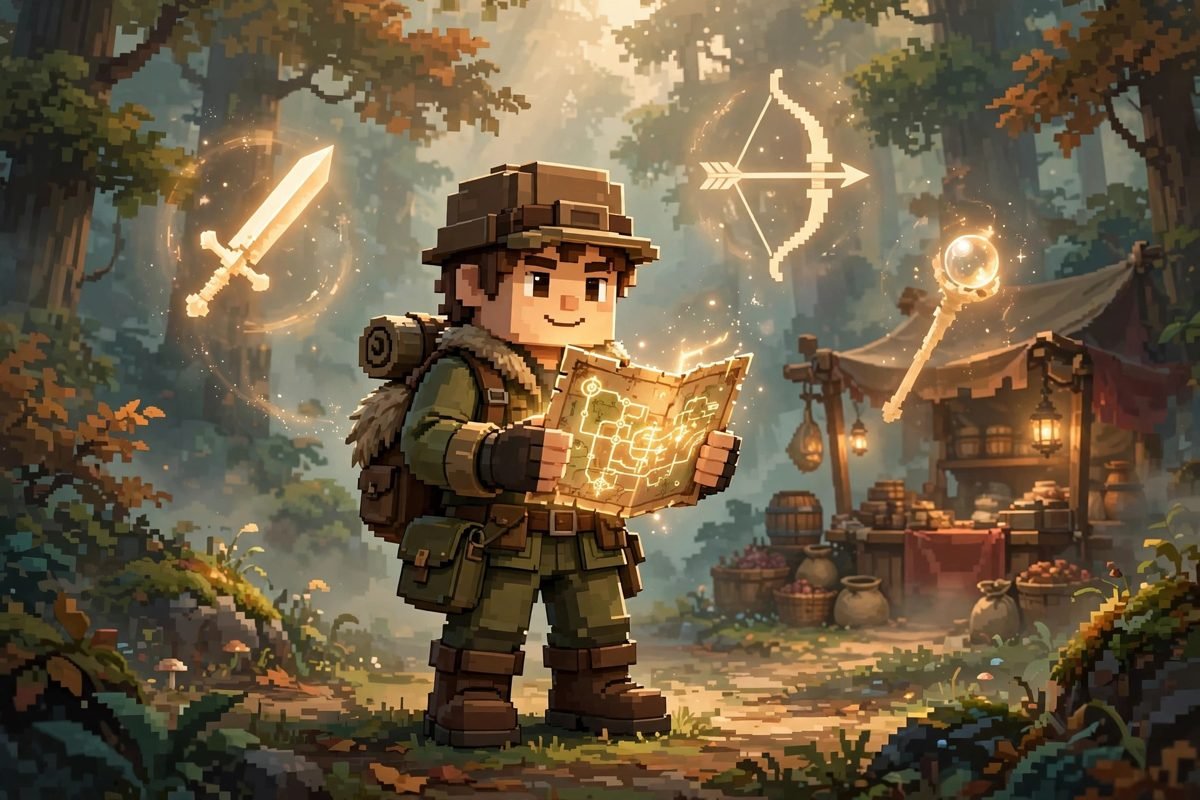
The “forest” fragment points to one of gaming’s most beloved settings. Forests appear everywhere: as biomes in survival games, as levels in platformers, as entire open worlds in adventure games. They are popular for a reason — dense geometry creates natural cover, verticality, secrets, and atmosphere.
Forests in survival and sandbox games
In games like Minecraft, forests are resource hubs: wood, the most important early-game material, plus food (apples), mobs to hunt, and terrain for hidden bases. Forest variants — birch, dark oak, jungle, taiga — each change the gameplay: dark oak forests spawn hostile mobs in daylight thanks to their canopy; jungles hide temples; taigas offer sweet berries and wolves. Learn your forest types and you learn the game’s early economy.
Forest levels in action and adventure games
Forest levels are the classic “second world” — after the tutorial plains comes the woods, where the game introduces verticality, hidden paths, and ambush enemies. The design language is consistent across decades: canopy for secrets, clearings for arenas, streams for navigation landmarks. When you are lost in a forest level, follow water — designers almost always place streams along the critical path.
Why forests feel the way they do
Game designers love forests because they control sightlines. A forest is the opposite of an open plain: you cannot see far, which means the game can surprise you, pace encounters, and hide rewards. That restricted visibility creates the forest’s signature feeling — cozy and dangerous at once. It is also why horror games set so many scenes in woods: the design toolkit is identical, just with the lighting turned down.
Shop Analysis: Reading the In-Game Economy
The “shop analysis” fragment is the most specific of the bunch — and the most useful. Every game with an economy has shops, and every shop has traps. Learning to analyze a shop’s inventory is a skill that transfers across every game you will ever play.
The three questions for every shop
Before buying anything, ask:
- Can I get this for free? If the item drops from enemies, grows on farms, or comes from quests, the shop price is a convenience fee. Pay it only when your time is worth more than the grind.
- Does this scale? Early-game gear that gets replaced in an hour is never worth premium currency. Buy consumables and upgrades, not equipment you will outgrow.
- What is the sell-back ratio? Games that buy your loot for 10% of the shop price are telling you something: items are meant to be found, not bought. The shop is a safety net, not a strategy.
Premium shops and real money
Shops that take real money deserve extra skepticism. The honest ones sell cosmetics — skins, emotes, decorations — that do not affect gameplay. The predatory ones sell power, progress, or gambling mechanics (loot boxes) disguised as fun. A useful test: if the game refuses to show you drop rates or prices upfront, it is designed to make you spend without thinking. Walk away.
Original insight: the best shop strategy is patience
Across hundreds of games, one pattern holds: the player who waits buys better. Shop inventories refresh, seasonal sales arrive, quest rewards obsolete early purchases, and late-game currency flows faster than early-game currency. The beginner buys the shiny sword at level 3; the veteran saves for the upgrade that matters at level 30. In-game wealth, like real wealth, compounds for the patient.
Finding Real Guides (and the PlayBattleSquare Connection)
So where does classes missions forest shop analysis playbattlesquint actually lead? The “playbattlesquint” fragment strongly suggests the searcher wanted guides on a gaming blog — and if that blog is PlayBattleSquare-flavored, you are in the right neighborhood. This site publishes exactly the kind of practical gaming guides the query was reaching for: class and mechanic breakdowns, mission walkthroughs, biome guides, and honest analysis.
A note of honesty, since this site takes accuracy seriously: contactplaybattlesquare.com is a gaming blog, not a game platform. It does not run matchmaking servers, sell in-game items, or employ game masters. It publishes guides — like this one. If you arrived here through a mangled search, welcome: the guides are real, the advice is tested, and the weird query that brought you here has been fully decoded.
Classes Missions Forest Shop Analysis Playbattlesquint FAQ
What does “classes missions forest shop analysis playbattlesquint” mean?
It is a garbled search string combining four gaming topics (classes, missions, forest content, shop analysis) with “playbattlesquint,” a typo of the gaming blog name PlayBattleSquare. The intent was almost certainly to find gaming guides on those topics.
Is Playbattlesquint a real game or website?
No. There is no game, platform, or website called Playbattlesquint. It is a misspelling of PlayBattleSquare, which is a gaming blog — not a game with servers, shops, or staff.
What is the best class for a beginner?
The warrior or tank archetype. It forgives positioning mistakes, has simple decision-making, and lets you learn game mechanics without dying constantly.
Should I do side missions or main missions first?
Mix them. Do side missions to level up and learn mechanics, then push the main story when you feel overpowered rather than underpowered.
How do I analyze an in-game shop?
Ask three questions: can I get this item for free, does the purchase scale into the late game, and what is the sell-back ratio. Buy consumables and upgrades, not gear you will outgrow.
Why are forests so common in games?
Dense forest geometry gives designers control over sightlines, which lets them pace encounters, hide secrets, and create atmosphere. Forests are resource-rich in survival games and atmospheric in adventure games.
Conclusion
Classes missions forest shop analysis playbattlesquint turned out to be a map, not a destination — five fragments pointing at the same desire: better gaming guides. Now you have them: pick a class that matches your decision load, treat missions as the designer’s lesson plan, read forest levels through their sightlines, and analyze every shop with the three-question test. The query was garbled; the answers are not.
For a broad overview of the medium itself, see Wikipedia’s video game overview. And for more practical guides in the same spirit, our PlayBattleSquare guide is the natural next stop. Happy gaming — and may your future searches be less eventful.