
Every long-term Minecraft world accumulates treasures: the first diamond sword, a dragon egg, a full set of ancient armor, maps of distant lands. Most of it ends up in a chest, forgotten. Minecraft museum ideas solve that problem — they turn your loot into a destination, a building that tells the story of your world and gives friends a reason to visit.
This guide covers 15 minecraft museum ideas — from grand halls to quirky themed exhibits — plus the display techniques that make exhibits look professional, building styles for the museum itself, and tips for running a museum on a multiplayer server. Whether you’re searching for “minecraft museaum” inspiration or planning a serious build, you’ll find something worth curating here.
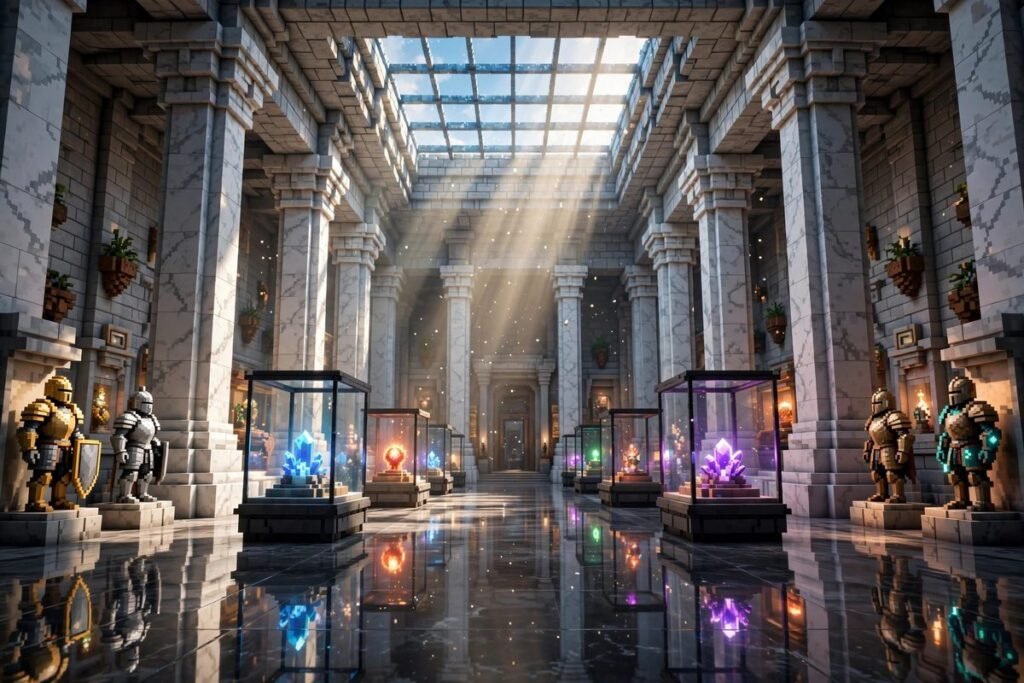
Table of Contents
What Makes a Great Minecraft Museum?
Before the ideas, the principles. The best minecraft museum ideas share three traits:
- A story. Random items in frames are a storage room. Items arranged to tell the story of your adventures — the first night, the first dragon fight, the great ocean expedition — are a museum.
- Deliberate display. Lighting, spacing, labels, and pedestals separate exhibits from clutter. A single diamond on a lit pedestal with a sign feels valuable; a chest of diamonds feels like inventory.
- A journey. Real museums guide visitors through rooms in sequence. Even a small museum feels grand when rooms flow: entrance, themed halls, a centerpiece, and a gift shop (yes, really — more on that below).
Display Techniques: The Curator’s Toolkit
Great minecraft museum ideas depend on great display craft. Master these techniques first:
- Item frames + pedestals: Place an item frame on a fence post, pillar, or chiseled block. The item floats at eye level — instant exhibit. Rotate items in frames for the perfect angle.
- Armor stands: The backbone of any equipment exhibit. One stand per armor set, arranged in progression rows (leather → netherite) tells the story of your gear at a glance. In Bedrock, stands have arms by default; in Java, commands can add arms and poses for dramatic displays.
- Signs and lecterns: Every exhibit needs a label. Signs give the name and date; lecterns with written books give the full story. “Dragon Egg — recovered from the End, expedition of March” beats an unlabeled egg every time.
- Glass cases: Surround precious items with glass panes or blocks. It reads as “valuable” instantly and protects against accidental pickup.
- Lighting design: Lanterns, sea lanterns, glowstone behind tinted glass, and end rods create gallery lighting. Light each exhibit individually rather than flooding the room — contrast is what makes displays pop.
- Map walls: Cover a wall with item-framed maps of your world at matching zoom levels for a living atlas. It’s the single most impressive museum feature per unit of effort.
- Redstone interactivity: Pressure plates that light up exhibits as visitors approach, note blocks that play a theme per room, dispensers that hand out “audio tour” written books. Interactivity turns looking into experiencing.
15 Minecraft Museum Ideas
1. The Grand Hall of Armor
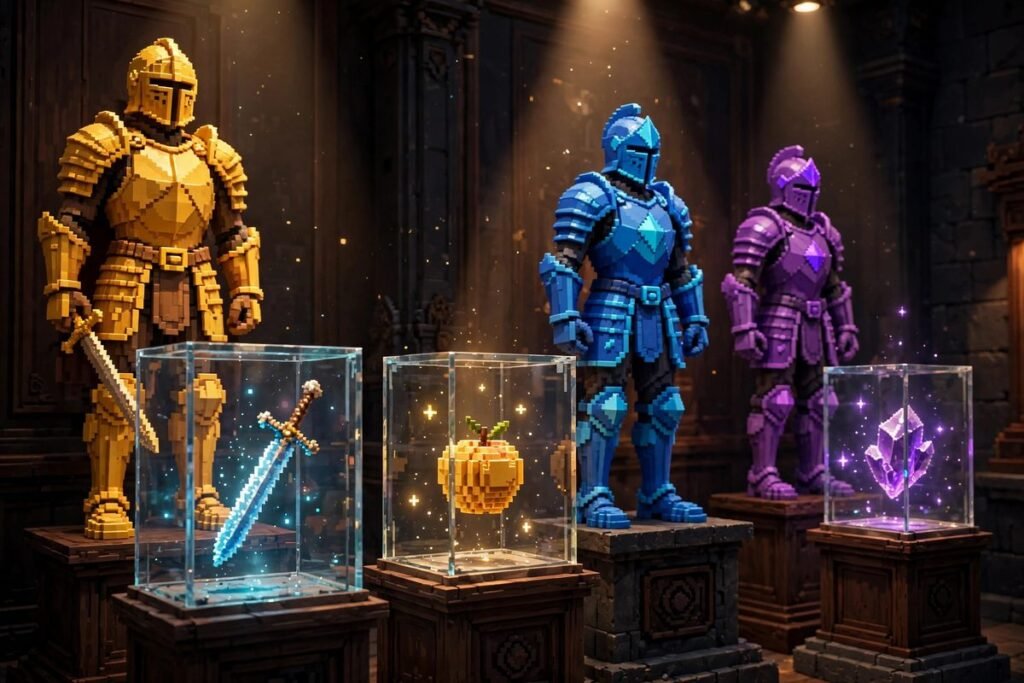
The classic. A long hall with armor stands displaying every armor tier in progression order — leather, gold, chainmail, iron, diamond, netherite — plus the turtle shell and any special sets. Add signs with the story of each set (“Iron Set — survived the first creeper ambush”). It’s the museum equivalent of a greatest-hits album.
2. The Mob Head Gallery
Creeper, zombie, skeleton, wither skeleton, dragon, and player heads arranged like hunting trophies. Charged-creeper farms make this achievable in survival. Arrange by rarity, with the dragon head as the centerpiece under a spotlight.
3. The Ore & Treasure Vault
Every ore block, raw and refined: coal through netherite, plus emeralds, lapis, redstone, and quartz. Display them in geological order with a “mining depth” theme — deepslate variants at the bottom, surface ores at the top. It doubles as a beautiful color gradient.
4. The History of Your World
My favorite of all minecraft museum ideas: a chronological walk through your world’s story. Room 1: the first dirt hut (rebuilt). Room 2: the first diamond. Room 3: the Nether portal breakthrough. Final room: the dragon egg. Nobody else’s museum can have this exhibit — it’s yours alone.
5. The Art Gallery
Minecraft paintings are underrated exhibits. Collect every painting variant, frame them in a well-lit gallery with benches (stairs) for “viewing.” Add map art — giant pixel artworks rendered as maps — for a modern wing. It’s the most peaceful room in any museum.
6. The Aquarium Wing
Glass tanks with tropical fish, axolotls, and coral. Each tank labeled with the biome the creatures came from. Axolotl tanks are the crowd favorite — build a dedicated “axolotl sanctuary” room and watch visitors lose their minds.
7. The Redstone Inventions Hall
Display your contraptions as exhibits: the first auto-farm, the sorting system, the hidden door. Use glass walls so visitors can see the circuitry, with signs explaining what each machine does. It’s a museum of your own engineering.
8. The Biome Dioramas
Miniature biome recreations in glass cases: a desert with cactus and a tiny pyramid, a snowy tundra with spruce, a mushroom island. Each diorama is a self-contained landscape — like a snow globe of your explorations.
9. The Weaponry Exhibit
Every sword tier, the enchanted “god sword,” bows, crossbows, tridents, and maces — displayed on armor stands with arms or in item frames. Include the story of each weapon’s greatest kill. (Respectful toward the creepers, of course.)
10. The Map Room
A dedicated cartography hall: wall-sized map grids of your explored world, explorer maps from cartographers, treasure maps from shipwrecks, and banners marking discoveries. For the technical details on map zoom levels and markers, the display possibilities are enormous.
11. The Nether & End Wings
Two themed rooms for the other dimensions: Nether wing with ancient debris, netherite scrap, ghast tears, and blaze rods in a dark basalt-and-blackstone room; End wing with chorus fruit, end stone, shulker boxes, and the elytra as the crown jewel. The dimension shift in architecture makes these rooms feel like travel.
12. The Farm Animal Sanctuary
A living exhibit: every breedable mob in labeled pens — including the rare ones (brown pandas, blue axolotls, skeleton horses). It’s part museum, part zoo, and it’s the room kids visiting your server will never leave.
13. The “Museum of Failures”
The comedy wing: the half-broken anvil, the cursed items, the screenshot gallery of your worst deaths, the dirt house you lived in for a month. Every veteran player has these artifacts. Displaying them takes confidence — and it’s always the most relatable room.
14. The Community History Museum (Multiplayer)
On a server, dedicate a hall to the community itself: the founding members’ first builds, the great prank war of last summer (documented with signs), the server’s first dragon fight. Let players donate their own artifacts with signed books telling the story. It becomes the server’s memory.
15. The Rotating Exhibition Hall
Leave one grand room empty — deliberately. Rotate exhibits monthly: “This month: ocean monuments.” It gives the museum a reason to revisit and turns curation into an ongoing hobby rather than a finished project.
Building the Museum Itself: Architectural Styles
The building should be worthy of its contents. Minecraft museum ideas for the structure:
- Neoclassical: Quartz pillars, grand staircases, domed roofs, symmetrical wings. The “real museum” look — impressive and instantly readable.
- Modern glass: Glass walls, clean lines, floating exhibits. Lets the contents be the architecture; great for art galleries.
- Ancient temple: Stone bricks, moss, jungle or desert motifs. Perfect for archaeology-themed collections.
- Underground vault: Carve the museum into a mountain or below ground. Deepslate, dramatic lighting, a sense of descending into treasure.
- Floating island: A museum in the sky, reached by elytra or a grand staircase. Impractical, unforgettable.
Whatever the style, plan the visitor flow: entrance lobby with a directory (signs or a book), themed wings branching off a central hall, and the centerpiece exhibit at the far end so visitors journey toward it.
Multiplayer Museum Tips
Running a museum on a server adds social dimensions:
- Protect it. Use land-claim plugins or build in a protected spawn area. Nothing kills a museum faster than a griefer with flint and steel.
- Accept donations. Set up a donation chest with a sign explaining what the museum collects. Players love contributing — and every donation comes with a story.
- Charge admission (optionally). A diamond or a few emeralds for entry funds expansion. Or keep it free and run a gift shop selling maps, souvenirs, and “I visited” books.
- Host events. Exhibition openings, guided tours, “night at the museum” mob-spawn events. A museum that’s also a venue stays alive.
Common Museum-Building Mistakes
- No labels. Unlabeled exhibits are just items in frames. The story is the exhibit — write it down.
- Overcrowding. Ten exhibits in a room feel curated; a hundred feel like a storage warehouse. Less is more.
- Flat lighting. A single light level across the whole room kills drama. Light exhibits individually; let corridors be dimmer.
- No flow. If visitors wander randomly, the story is lost. Guide them: halls, doorways, and directory signs.
- Building too big first. Start with one excellent room, not ten empty halls. Expand as the collection grows.
Minecraft Museum Ideas FAQ
What should I put in a Minecraft museum?
Anything with a story: first diamonds, rare drops, armor progression sets, mob heads, maps of your explorations, and mementos of your world’s history. The story matters more than the rarity.
How do you display items in a Minecraft museum?
Item frames on pedestals for small items, armor stands for gear, glass cases for valuables, signs and lecterns for labels, and map walls for cartography. Light each exhibit individually for gallery effect.
How do you make a museum in Minecraft step by step?
Pick a theme, choose a building style, lay out rooms with a visitor flow (entrance → themed halls → centerpiece), build display cases and lighting, then curate exhibits with labels. Start with one great room and expand.
What is a good size for a Minecraft museum?
Start small — a 15×15 single hall is plenty for a first museum. Grand museums grow to 50×50 or larger with multiple wings, but empty grand halls feel worse than full small ones.
Can you make a working museum on a multiplayer server?
Yes — and they’re some of the best community builds. Protect the area with claims, accept artifact donations with story books, and consider a gift shop or admission fee to fund expansion.
Conclusion
The best minecraft museum ideas aren’t about the rarest items — they’re about the best stories. A museum turns a world’s scattered treasures into a destination with a narrative: where you’ve been, what you’ve survived, and what it all meant. Start with one room, label everything, light it like you mean it, and let the collection grow.
For the technical details on posing and customizing armor-stand displays, see Minecraft Wiki’s armor stand guide. And when your exhibits need proper display furniture, our guide to crafting tables covers the blocks that make great pedestals. Now go curate something worth visiting.