
If you have ever wondered about a table in Minecraft — which ones exist, what they do, and which you should build first — this guide covers them all. Minecraft has six table-type utility blocks, and each one unlocks a different slice of the game: crafting, enchanting, gear upgrades, maps, arrows, and banners. Here is every table in Minecraft, its recipe, and how to use it.
Crafting Table: The First Table Every Player Makes
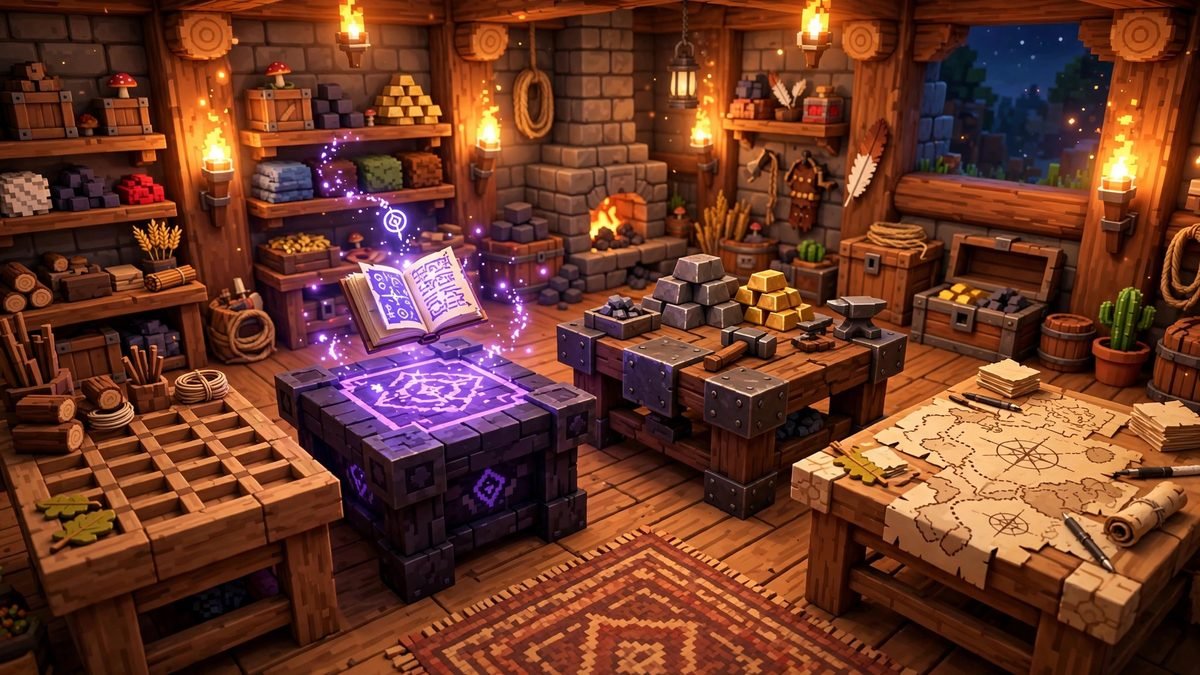
The crafting table is the most important table in Minecraft — full stop. Four planks in a 2×2 grid gives you the 3×3 crafting grid that unlocks nearly every recipe in the game, from tools to armor to complex redstone contraptions. Your inventory’s tiny 2×2 grid can only take you so far; the crafting table is what turns survival from scrambling into progressing.
A few things new players miss about it:
- It is also a repair station. Combine two damaged tools of the same type in the grid for a durability boost plus 5% — no XP cost, though enchantments are stripped (like a grindstone).
- It burns as fuel. A crafting table smelts 1.5 items in a furnace. Not efficient, but useful in a pinch.
- It appears in the world. Crafting tables generate in villages, igloos, witch huts, pillager outpost tents, and trial chambers — grab one instead of crafting your first.
- Recipe book included. The built-in recipe book (left of the grid) stores discovered recipes for one-click crafting.
For the full technical details, Minecraft Wiki’s crafting table page has everything, including breaking times and generation data.
Enchanting Table: The Magic Table
The enchanting table is the table in Minecraft that turns good gear into great gear. Recipe: 1 book on top, 2 diamonds on the sides, and 4 obsidian filling the bottom and middle. It is the most expensive table to craft — diamonds and obsidian mean you will not build one on day one.
How it works: place the table, surround it with up to 15 bookshelves (one block of air between), and spend XP levels plus lapis lazuli to roll enchantments on gear. More bookshelves mean access to higher-level enchantments, up to level 30.
Pro tips:
- 15 bookshelves is the magic number — arranged in a square around the table with one gap to walk in.
- Enchant books, not just gear. Books let you save good rolls and apply them later via anvil.
- Grindstone the misses. Bad enchantment? Strip it on a grindstone and re-roll — the table never runs out of chances.
Enchantments are a deep rabbit hole — for one of the trickiest edition-specific cases, see our Sweeping Edge in Bedrock guide, which breaks down a Java-exclusive enchantment Bedrock players keep asking about.
Smithing Table: The Upgrade Table
The smithing table is the table in Minecraft for endgame gear. It has two jobs:
- Netherite upgrades: Combine diamond gear with a netherite ingot (plus a netherite upgrade smithing template, found in bastion remnants) to make netherite equipment — the strongest in the game.
- Armor trims: Apply decorative trim patterns to armor using trim templates found across the world, from trail ruins to ancient cities.
Unlike the anvil, the smithing table preserves enchantments through upgrades and costs no XP. It also gives unemployed villagers the toolsmith profession. If you have full diamond gear, the smithing table is your next mandatory build.
Cartography Table: The Map Table
The cartography table is the mapmaker’s table in Minecraft. Craft it with 2 paper on top of 4 planks. Its uses:
- Zoom out maps: Surround a map with paper to expand its coverage (up to 4 zoom levels).
- Clone maps: Combine a map with an empty map to duplicate it — perfect for sharing with friends.
- Lock maps: Combine with a glass pane to freeze a map’s contents permanently.
- Rename maps: Anvils rename maps, but the cartography table is where map editing happens.
It also assigns the cartographer profession to villagers — the ones who sell ocean explorer maps and woodland explorer maps, your ticket to ocean monuments and mansions. Explorer-map villagers alone make this table worth building.
Fletching Table: The Arrow Table
The fletching table is currently the simplest table in Minecraft: it has no functional GUI in survival. Craft it with 2 flint on top of 4 planks. Its real purposes:
- Fletcher villagers: It is the fletcher’s job site block — fletchers trade sticks for emeralds (one of the best early emerald sources) and sell arrows, bows, and crossbows.
- Fuel: It burns in furnaces like other wooden blocks.
- Future potential: Mojang has long hinted the fletching table may gain arrow-crafting functionality someday. For now, it is a villager block with great trades attached.
Do not skip it: a fletcher buying 32 sticks per emerald turns every forest into an emerald mine.
Loom: The Banner Table
The loom is the banner-designer’s table in Minecraft. Recipe: 2 string on top of 2 planks. It applies banner patterns — and it does it better than the crafting grid:
- No dye wasted on patterns: The loom applies patterns without consuming a banner pattern item.
- Pattern preview: See the result before you commit dyes.
- Shepherd villagers: The loom is their job site; shepherds trade wool and dyes and sell banners and paintings.
If you run a server with team colors, faction flags, or just like decorating, the loom is essential. Banner designs that take six dye steps in a crafting grid take seconds here.
All Tables in Minecraft Compared
Quick reference for every tables in minecraft players ask about:
| Table | Recipe | Main Use | Villager Job |
|---|---|---|---|
| Crafting Table | 4 planks | 3×3 crafting, repairs | — |
| Enchanting Table | Book + 2 diamonds + 4 obsidian | Enchant gear | — |
| Smithing Table | 2 iron + 4 planks | Netherite upgrades, trims | Toolsmith |
| Cartography Table | 2 paper + 4 planks | Map editing | Cartographer |
| Fletching Table | 2 flint + 4 planks | Villager trades (for now) | Fletcher |
| Loom | 2 string + 2 planks | Banner patterns | Shepherd |
Note the pattern: four of the six tables double as villager job sites, which makes them the backbone of any trading-hall build. When players search “tables minecraft” looking for the full set, this is the list they need.
Which Table Should You Build First?
Priority order for a new survival world:
- Crafting table — minute one, non-negotiable.
- Cartography table — cheap (paper + planks) and unlocks the cartographer villager.
- Fletching table — cheap and unlocks the stick-to-emerald trade.
- Loom — cheap; build when you want banners or a shepherd.
- Enchanting table — mid-game, once you have diamonds and obsidian.
- Smithing table — late game, when diamond gear is ready for netherite.
The original tip most guides skip: build your tables before you need villagers. Placing job-site blocks early in a village lets you shape which professions appear, rather than curing and converting villagers later.
Tables as Decoration and Building Blocks
Beyond their functions, tables in minecraft are some of the best-looking decorative blocks in the game. Builders use fletching tables as workbenches in workshops, cartography tables as desks in studies, and smithing tables as anvils in blacksmith builds. The loom’s colorful side texture makes it a natural fit for tailor shops and market stalls.
A few decorative tricks: the crafting table’s distinctive top texture reads as a “workbench” from a distance even in builds that never craft anything; the enchanting table’s floating book and particle effects make it a centerpiece for wizard towers and libraries; and the smithing table’s hammer-and-anvil texture sells any forge scene. Because all six are full solid blocks, they stack neatly, take redstone power, and support torches and other blocks on top — functional furniture in every sense.
Table in Minecraft FAQ
How many tables are there in Minecraft?
Six main table blocks: crafting table, enchanting table, smithing table, cartography table, fletching table, and loom. The grindstone, stonecutter, and anvil are similar utility blocks but are not called tables.
What is the most important table in Minecraft?
The crafting table — it unlocks the 3×3 grid that nearly every recipe requires. Every other table is a specialist; the crafting table is the generalist everything depends on.
Can tables be used as villager job sites?
Four of them can: smithing table (toolsmith), cartography table (cartographer), fletching table (fletcher), and loom (shepherd). The crafting and enchanting tables do not assign professions.
Which table is used for netherite upgrades?
The smithing table. Combine diamond gear with a netherite ingot and a netherite upgrade template — enchantments carry over and it costs no XP.
Is the fletching table useless?
Not quite — it has no crafting GUI, but it creates fletcher villagers with excellent stick-for-emerald trades. Mojang has hinted at future functionality.
Conclusion
Every table in Minecraft earns its place: the crafting table builds everything, the enchanting table powers up gear, the smithing table forges netherite, the cartography table masters maps, the fletching table fuels emerald trading, and the loom designs banners. Learn all six and your base becomes a proper workshop instead of a chest full of good intentions.