
The Minecraft lava block is the most dangerous thing in the Overworld that is not trying to kill you on purpose. It glows with the maximum light level in the game, deals brutal damage on contact, destroys nearly every item it touches, and — in the right hands — becomes one of the most useful resources in Minecraft: infinite fuel, obsidian on demand, mob-trap blades, and dramatic lighting all come from this glowing orange fluid.
This is the complete guide to the lava block: how it flows and how far, exactly how much damage it deals, where to find it, how to collect and farm it renewably, every practical use players have discovered, and how to survive it when things go wrong.
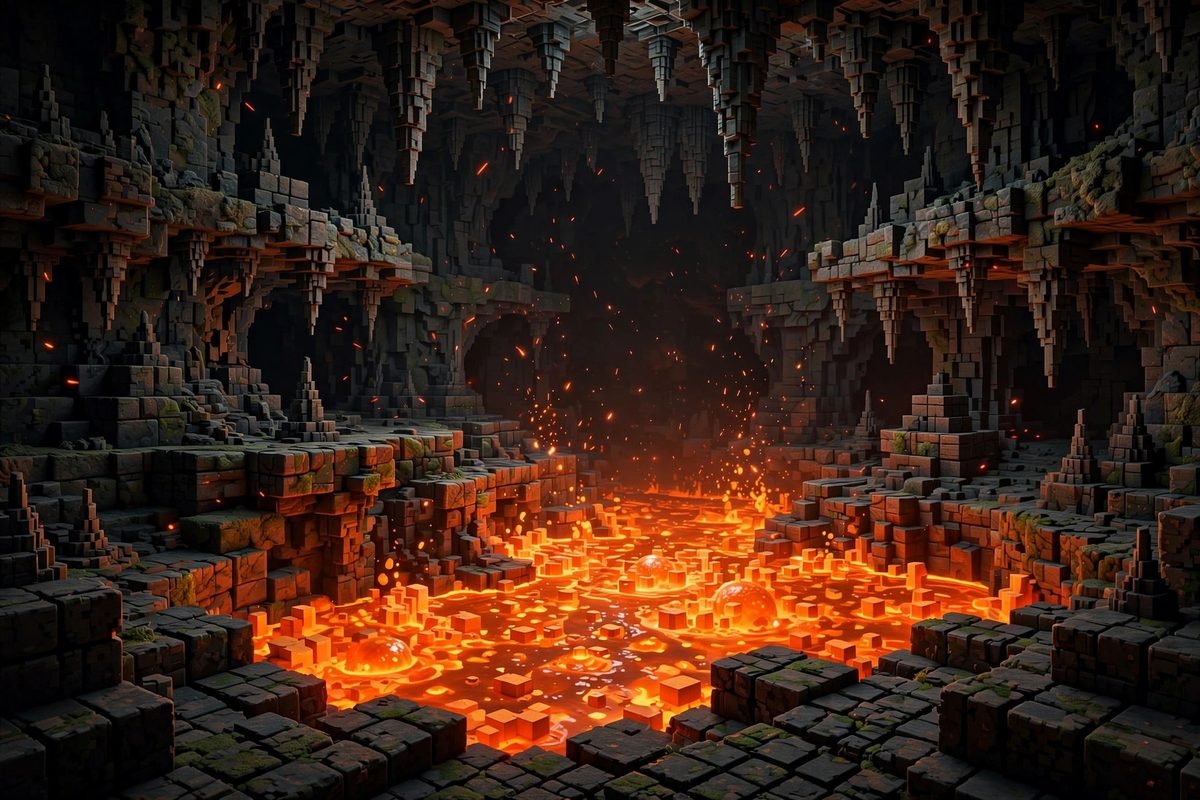
Table of Contents
What Is the Lava Block in Minecraft?
When players say “lava block”, they mean lava itself — the glowing orange fluid block found in caves and across the Nether. Technically it is a fluid, not a solid block: you cannot pick it up, punch it, or place it like stone. In modern versions it exists as a single block type (minecraft:lava) with two states, still and flowing, and the game treats both the same way for damage and light.
The minecraft lava block has three defining traits:
- It emits light level 15 — the maximum possible, equal to daylight and glowstone. Nothing in the game is brighter.
- It deals 4 HP (2 hearts) of damage per hit, striking roughly every half second while you touch it, and sets you on fire for about 15 seconds after you escape.
- It destroys items. Almost anything that falls in — tools, armor, diamonds — burns up. Only netherite gear and ancient debris survive.
Those decorative embers and fireballs drifting above lava? Purely cosmetic — they cannot start fires or hurt anything. The danger is the fluid itself.
How Lava Flows: Distance and Speed
Understanding lava flow is the difference between a controlled obsidian farm and a flooded base. The rules:
- Overworld and End: Lava spreads up to 4 blocks from its source (the source plus 3 blocks outward) across flat ground, advancing 1 block every 30 game ticks — about 1.5 seconds per block. It is dramatically slower than water.
- Nether: Lava spreads up to 8 blocks (source plus 7 outward) and flows at 1 block every 10 ticks — roughly three times faster than in the Overworld, about half the speed of Overworld water.
- Downhill: Like water, lava always seeks the lowest reachable point within a few blocks, which can redirect a flow toward drops you did not expect.
- Sources are finite: Unlike water, placing two lava sources side by side does not create a new source. Every bucket of lava you take is one bucket gone from that pool — unless you farm it (see below).
My original tip: because Overworld lava flows so slowly, you can outrun a spill on foot — but your items cannot. The classic disaster is breaking the wrong block above a lava lake and watching your inventory slide in. When working over lava, always crouch-sneak near edges and keep your most precious gear in an ender chest.
Where to Find Lava
Lava is everywhere once you know where to look:
- Deep caves: Below about Y=-55, lava lakes and aquifers are common — this is also prime diamond territory, which is why lava and diamonds are forever linked in players’ minds.
- Surface lava lakes: Small lava pools generate above Y=0 in almost any Overworld biome. They are often ringed with stone and sometimes set nearby trees on fire.
- Lava springs: Single source blocks pouring down cliff faces and cave walls.
- Villages: Weaponsmith buildings contain a couple of lava source blocks — a convenient early-game pickup.
- Strongholds: The End portal room has lava along the walls and under the portal frame.
- The Nether: Lava is more common than water is in the Overworld. Entire seas of lava sit at around y=32, stretching for hundreds of blocks. The Nether is effectively an ocean where the water wants you dead.
How to Collect Lava: Buckets and Cauldrons
You cannot craft lava and you cannot pick it up with your hands. Collection works one way:
- Craft a bucket from 3 iron ingots in a V shape at a crafting table.
- Right-click a lava source block (the still, full-textured lava — not the flowing kind) with the empty bucket.
- You now hold a lava bucket. Right-click again to pour the source back out; the bucket is returned to you.
Flowing lava cannot be bucketed, and lava has no item form in survival — the bucket is the only container. One bucket holds exactly one source block, so stocking up for a big project means multiple trips or a farm.
Farming Lava Renewably With Dripstone
Here is the trick that changed lava economics forever: lava is renewable. Place a pointed dripstone stalactite with a lava source above it and a cauldron below, and drips will slowly fill the cauldron — roughly a 6% chance per random tick, averaging around 19 minutes per fill. Then scoop the full cauldron with a bucket.
A row of these setups gives you infinite lava without ever visiting a lake again. Build it with non-flammable blocks (a stray fire would be ironic and catastrophic), keep the dripstone directly under the lava source, and make sure nothing but air sits between the dripstone tip and the cauldron. Original insight: build your lava farm directly above your super-smelter room. The farm drips passively while you do other things, and you are never more than a ladder-climb from refueling.
What Happens When Lava Meets Water
The lava–water reaction is one of Minecraft’s most important mechanics:
- Water touching a lava SOURCE block → obsidian. This is how you make obsidian: the dark purple block needed for Nether portals and enchanting tables.
- Water touching FLOWING lava → cobblestone. This is the basis of every cobblestone generator ever built.
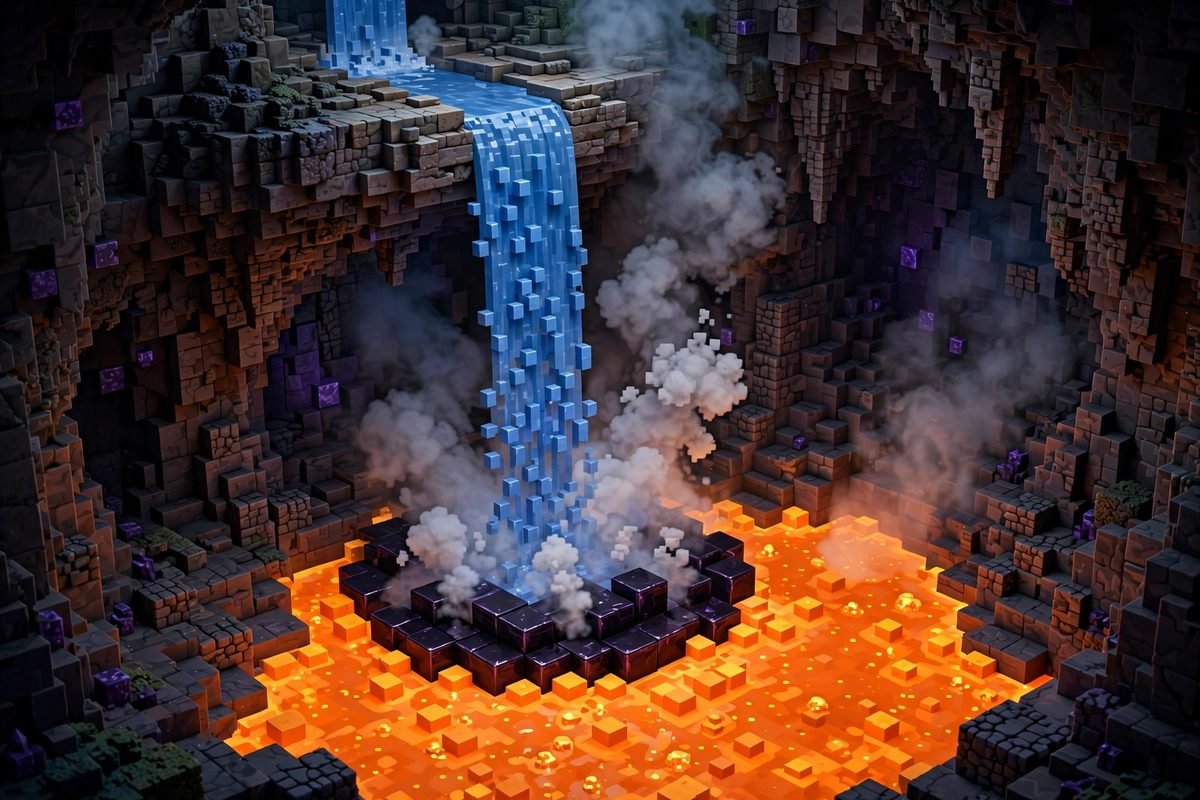
The classic obsidian farm: dig a pit, pour lava sources in a row, then run water over the top. Each source converts to obsidian, which you mine with a diamond pickaxe. And the reverse trick — pouring water over a lava lake surface — is how players safely “cap” dangerous lakes while caving: the top layer turns to obsidian or cobblestone and you can walk right over.
Two more reactions worth knowing: lava flowing over blue ice next to soul soil creates basalt, and water flowing over lava sources in ocean ravines generates magma blocks — the bubble-column blocks that drag you down (or push you up, with soul sand).
The Best Uses for Lava in Minecraft
Veteran players treat the lava block minecraft veterans love as a multi-tool. Here are the proven uses, ranked by how much they change your game:
1. The Best Furnace Fuel in the Game
A lava bucket smelts 100 items — more than any other fuel, beating even a block of coal (80 items). It burns for 1,000 seconds, and the bucket is returned once smelting starts. If you have a dripstone lava farm, you have free infinite fuel forever. One bucket per full furnace load, no coal mining required.
2. Obsidian on Demand
Nether portals need 10 obsidian minimum; enchanting tables need 4. The water-over-lava-source trick turns any lava lake into an obsidian quarry. Pro move: bring the water to the lava rather than hauling lava home — a single water bucket converts a whole lake surface.
3. Mob Traps and Lava Blades
A thin sheet of lava (one block deep, with signs to hold it in place) kills most mobs while letting their drops fall through to hoppers below. These “lava blades” are the classic mob-farm killer — though note that they also burn drops like they burn everything else, so item-sorting farms often prefer fall damage or trident killers for valuable loot.
4. Trash Disposal
A single lava source in a hole (or a cauldron of lava, which is safer) is the ultimate garbage can. Throw in junk blocks and items and they are gone forever. Every organized base has one — usually labeled, because an unlabeled lava hole is how you lose a full inventory of diamonds.
5. Lighting and Decoration
Light level 15 makes lava the brightest light source available. Behind glass panes or in a “lava lamp” column (glass blocks with lava inside), it creates dramatic lighting for Nether-themed builds, forges, and throne rooms. Just remember: flammable blocks within a couple of blocks can catch fire, so build lava features from stone, glass, and other non-flammable materials.
6. Defense
A lava moat around a base is the oldest trick in the book. Mobs path straight into it and die; raiders think twice. It is indiscriminate, though — you will need a safe bridge, and anything you drop near the moat is gone.
Lava Damage: Exactly How Deadly Is It?
Let us be precise, because this determines whether you survive a mistake:
- Contact damage is 4 HP (2 hearts) per hit, landing about every half second.
- Leaving lava does not end the danger — you stay on fire for roughly 15 seconds, taking burn ticks that will often finish what the lava started.
- Water or rain extinguishes the fire, but does nothing about the direct lava damage while you are still in it.
- With no armor, you last about 2.5 seconds in lava. Full iron buys you around 5.5 seconds; full diamond about 10.5; full netherite about 11.
- Fire Resistance potion makes you immune to both the contact damage and the burning — you can swim in lava (very slowly, about a third of water speed). An 8-minute extended potion crosses most Nether lava lakes.
- Armor enchanted with Fire Protection dramatically extends survival — with enough of it plus a full hunger bar, natural regeneration can actually outpace lava damage.
Most Nether mobs (blazes, ghasts, magma cubes, striders, wither skeletons, zombified piglins) are immune to lava, which is why a lava moat does nothing against a Nether fortress’s natural residents. Striders, famously, walk on lava — saddling one is the intended way to cross Nether lava seas.
Lava and Fire Spread: Protecting Your Builds
Lava does not just hurt you — it can burn your house down. Air blocks directly above lava (and two blocks above, in a wider radius) can ignite if there is flammable material nearby, and fire then spreads on its own. The practical rules:
- Never build lava features from wood, wool, or leaves. Use stone, cobblestone, glass, iron, or deepslate.
- Keep lava at least 3 blocks from anything flammable, including wooden walls, carpet, and item frames near lava lamps.
- Surface lava lakes can ignite nearby trees — if you build near one, clear the vegetation or replace the lake surface with cobblestone.
- On servers, check whether fire spread is disabled by gamerule — many servers turn it off, which makes lava decoration far safer.
Original insight: the safest lava lamp design is a 3×3 glass column with the lava source in the center, surrounded by a 1-block air gap and then your build materials. The air gap means even if fire-spread rules are on, there is nothing flammable within ignition range. I have run this design on hard-mode servers for years without a single incident.
Common Lava Mistakes
- Bucketing flowing lava. Only still source blocks fill a bucket. If your bucket “does nothing,” you are clicking flowing lava.
- Mining straight down (or up) near lava. The two oldest deaths in Minecraft both involve lava. Always stand back and mine at an angle.
- Carrying everything into the Nether. Assume you will die in lava at least once. Ender chest your valuables; netherite gear survives lava, everything else does not.
- Forgetting the after-burn. Escaping the lava pool is only half the rescue — you then burn for 15 seconds. Jump in water immediately or drink Fire Resistance before you go in.
- Thinking lava creates infinite sources. Water duplicates; lava does not. Every bucket you take permanently lowers the pool unless you farm it with dripstone.
Minecraft Lava Block FAQ
Can you make a lava block in Minecraft?
No — there is no crafting recipe for lava. You collect it with a bucket from natural sources, farm it renewably with pointed dripstone and a cauldron, or place it in Creative mode. The minecraft lava block only exists as a placed fluid in survival.
How far does lava flow in Minecraft?
In the Overworld and End, lava spreads up to 4 blocks from its source (source plus 3 outward) at about 1 block per 1.5 seconds. In the Nether it reaches 8 blocks and flows roughly three times faster.
What does water do to lava?
Water touching a lava source block creates obsidian; water touching flowing lava creates cobblestone. This is the foundation of obsidian farming and cobblestone generators.
Can you swim in lava in Minecraft?
Yes, with a Fire Resistance potion — you take no damage and move very slowly through it. Without the potion, you die in seconds and burn for 15 seconds after escaping.
Does lava destroy netherite?
No. Netherite items and ancient debris are the only items immune to lava and fire. Everything else — including diamonds — burns.
Is lava a good fuel?
It is the best fuel in the game: one lava bucket smelts 100 items over 1,000 seconds, beating a block of coal. The bucket is returned after smelting starts.
How do you farm lava infinitely?
Place a lava source above a pointed dripstone stalactite with a cauldron underneath. Drips slowly fill the cauldron (about 19 minutes on average), and you scoop it with a bucket — infinite lava with zero mining.
Conclusion
The Minecraft lava block is danger and opportunity in one glowing package: maximum light, brutal damage, infinite fuel, free obsidian, mob-trap blades, and the best trash can in the game. Respect the flow rules, farm it with dripstone instead of hauling buckets, keep flammables at a distance, and always — always — bring Fire Resistance to the Nether.
For the full technical reference on flow mechanics, damage values, and generation, see Minecraft Wiki’s lava page. And if you are still setting up your first crafting setup for all those buckets, our crafting table guide has you covered. Now go tame that glowing orange menace — carefully.
Pingback: Block Lava Minecraft: The Lava Block Explained
Pingback: Minecraft Lava Source Block: How to Get & Farm Them